


When Life Eventually Returns to Nature: The Poetic Landscape and Spirit of Place at Stockholm's Woodland Cemetery
Updated: Aug 25
As one of the world's classic masterpieces of cemetery design, Stockholm's Woodland Cemetery (Skogskyrkogården), which was inscribed on the UNESCO World Heritage List just over fifty years after its completion, is a major work created jointly by two of Sweden's most important twentieth-century architects, Gunnar Asplund and Sigurd Lewerentz.
In 1915, Gunnar Asplund and Sigurd Lewerentz won the competition with a proposal that sought to intervene as little as possible in the existing terrain and vegetation. Construction began in 1917, with the project being built and opened in stages. During this period, it underwent extensive revisions and adjustments, including the incorporation and simplification of ideas from other competition entries as requested. The project ultimately took 23 years to complete, reaching full completion in 1940.
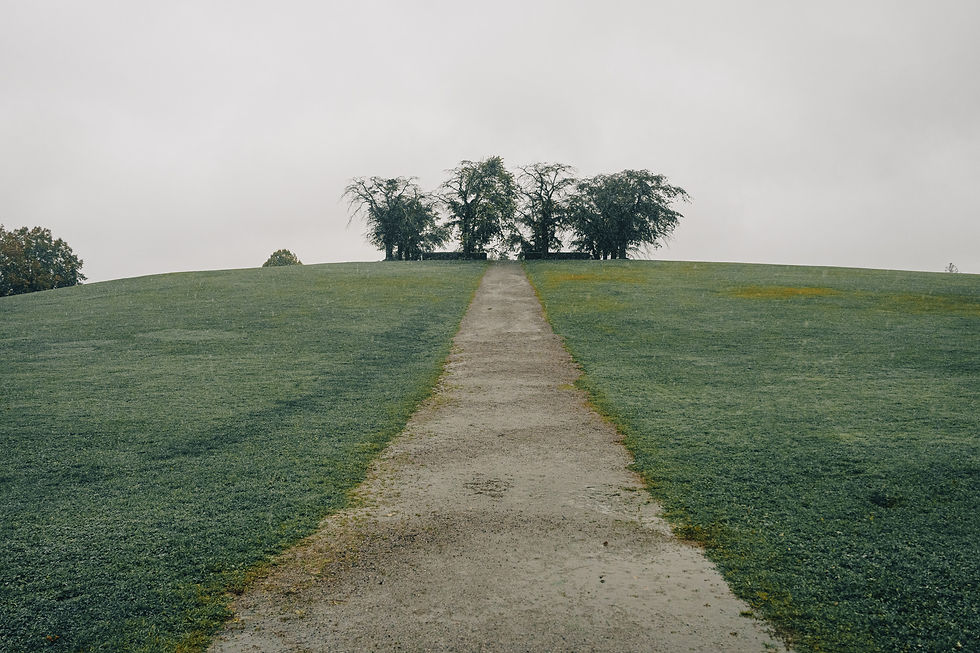
Gunnar Asplund was responsible for the Chapel of the Holy Cross, the crematorium, and the Woodland Chapel, while Sigurd Lewerentz designed the landscape of the entire cemetery, structured around the long axis extending from the Meditation Grove through the Seven Springs Way, as well as the Chapel of Resurrection at the end of the axis.
The cemetery was transformed from a former quarry and covers more than 100 hectares. It was also part of Sweden's twentieth-century efforts to provide social welfare support for the funeral arrangements of its citizens. Following Gunnar Asplund's death, he was buried here in the same year the cemetery was fully completed.
The development of modern architecture in the Nordic countries can be understood as a progression from the period of classicism to experiments with modern functionalism, and ultimately toward a Nordic regional character shaped through the integration of local culture. It reflects a way of life emphasizing simplicity and restraint, accompanied by an atmosphere of natural and understated qualities.
The two Swedish architects responsible for the Woodland Cemetery happened to be working precisely during this transitional period from classical architecture toward modernity. The architectural language of the cemetery can be described as possessing a simplified and restrained classical character, while its broader development also offers a glimpse into the evolution of ideas that would later emerge in several of the two architects' major works.
Yet compared with the architecture itself, what makes the Woodland Cemetery most remarkable is the creation of its overall spirit of place. It deeply responds to a Nordic worldview that values coexistence with nature and a harmonious relationship between humanity and the natural world. With the forest serving as one of the most symbolic landscapes of the Nordic region, this quality is expressed remarkably naturally throughout the cemetery. Through the careful arrangement of terrain and woodland, the experience of moving through the site creates a powerful physical and emotional response.

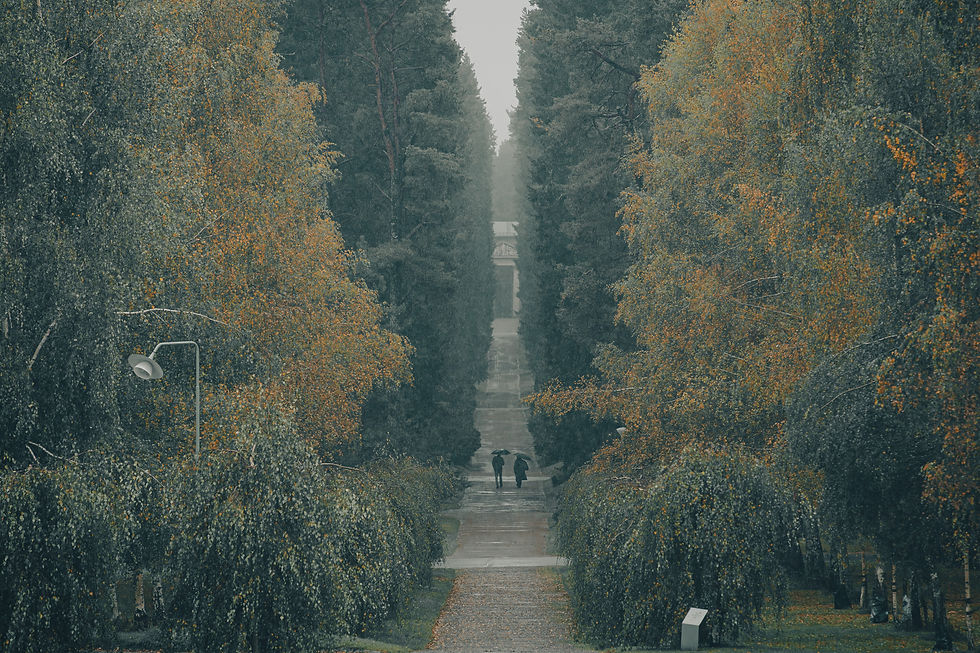
During my visit to the Woodland Cemetery on October 9, 2024, I unfortunately encountered heavy rain. Already feeling unwell with a cold, and unable to enter any of the interior spaces, the entire experience could hardly have been more bleak and stormy. Yet from another perspective, seeing people arriving to attend funerals beneath black umbrellas seemed to create a poignant and almost poetic sense of beauty within the cemetery. Through this experience, I was left with an enduring realization: that life will eventually return to nature.


Comments