


Creating Paradises for the World: Entering Aalto's Home in Search of a True "Dwelling"
Updated: Aug 25
As one of Finland's national architectural treasures, Alvar Aalto has exerted a profound influence on the world far beyond the already considerable fame of the four great figures of modernist architecture. Much of what is now widely recognized as the Scandinavian design sensibility—including the Nordic aesthetic so popular today—can be traced back to the rich body of work developed under Aalto's direction, extending from architecture to furniture and domestic objects.
Looking back from the present day at the ideas that Aalto sought to express, his approach remains remarkably relevant in terms of the fundamental meaning of architecture. His human-centered perspective, together with his sensitivity to the relationship between society and the environment, returns architecture to an understanding of itself as an art of creating the conditions of everyday life. At the same time, in his exploration of architectural form, the integration of geometry, materials, light, and color reveals a distinctly personal aesthetic vision. On the one hand, Aalto addressed the experience of living within space through a more humane interpretation of modern functionalism; on the other, he drew deeply from the Nordic landscape, incorporating the quiet, natural character of its forests and lakes, as well as a certain sense of isolation from the outside world. In doing so, his architecture reflects a broader historical process of Nordic modernization: while absorbing the ideas of avant-garde modern art from continental Europe, it continually drew upon local traditions and elements of classicism as sources for an evolving spatial language.
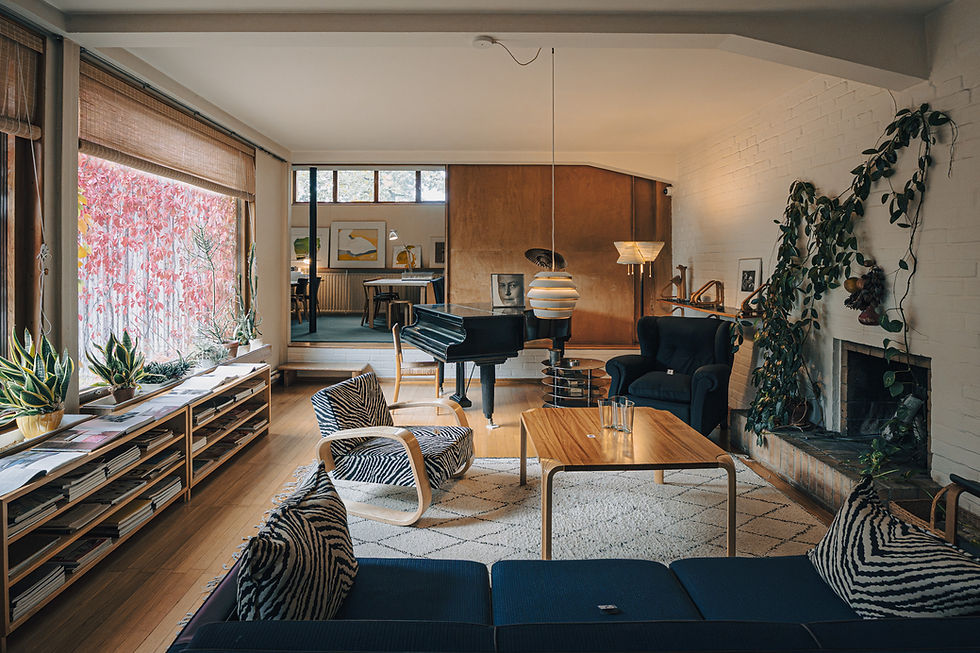
The Aalto House, visited on October 6, 2024, was designed jointly by Alvar Aalto and his first wife, Aino Aalto, after the couple purchased a hillside site on the outskirts of Helsinki in 1935. The house was completed in 1936. Its program combined a private family residence with a studio for their architectural practice, which was later relocated to a separate office building constructed nearby. In many ways, this modest house can be regarded as the beginning of the dream that would lead the Aaltos toward a remarkable series of later architectural works.

In contrast to some of Aalto's earlier projects, in which he experimented with different architectural languages ranging from classicism to rationalism, this house represents an early stage in which his individual architectural thinking began to reach greater coherence. It expressed a new possibility for architecture through a more deeply local and humane perspective. Beyond the basic functional organization of modern architecture, the house introduced a richer imagination of everyday life, manifested through experiments with materials and architectural elements, as well as through the tactile relationships between furniture and the spaces in which it was placed. It can therefore be understood as an accomplished expression of the principle of Total Design, in which architecture and its furnishings are conceived as an integrated whole.
At the level of massing and spatial composition, the house also develops a rich sequence of transitions between inside and outside. Its street-facing northern side is relatively closed, while the southern facade opens toward the garden. Through an organically articulated facade of natural materials, together with the integration of planting and landscape, the boundaries between architecture and its surroundings gradually dissolve, allowing the house to become part of its environment.


Compared with the many celebrated modernist houses by renowned architects that I had encountered before, the Aalto House feels much closer to the idea of a true "home." This idea is not merely a matter of external form, but a deeper return to the inward experience of the body. It traces dwelling back toward a primitive human instinct: beginning with the self as the subject of a phenomenological observation of the surrounding environment, and from there creating a place of shelter, comfort, and the everyday dreams of living.
For Alvar Aalto, this may also reveal what he regarded as the ultimate purpose of architecture: to continually strive to create "paradises" for people.


Comments